
There is a pattern on almost every street in Lisbon: that apartment with the blinds always down, the overflowing mailbox, that no one lives in or puts up for sale. For most people, it is just another abandoned property. For an investor, it is an unanswered question: who does it belong to, and might it be available to sell?
The good news is that this is not looking for a needle in a haystack. In Portugal, almost every property leaves a trail: there are public records that link an address to a name. With method, you go from the façade to the owner, and from the owner to a profitable deal.
This is exactly the work behind the pillar of Hunting at our method: finding value where no one is looking. In this guide we show you how it is done, in two phases.
Why go after those who are not selling
A property that is not on the market is a property with no competition. There is no bidding war, no ten interested buyers pushing the price up, no intermediaries filtering the conversation. You speak directly with the decision-maker, often someone who had not even thought about selling, but who has a problem sitting there gathering dust.
Finding that property is the easy part: you see one on your street every day. What separates those who close a deal from those who just remark “what a shame it is like that” is knowing how to turn a façade into a contact.
Phase 1: From the property to the name
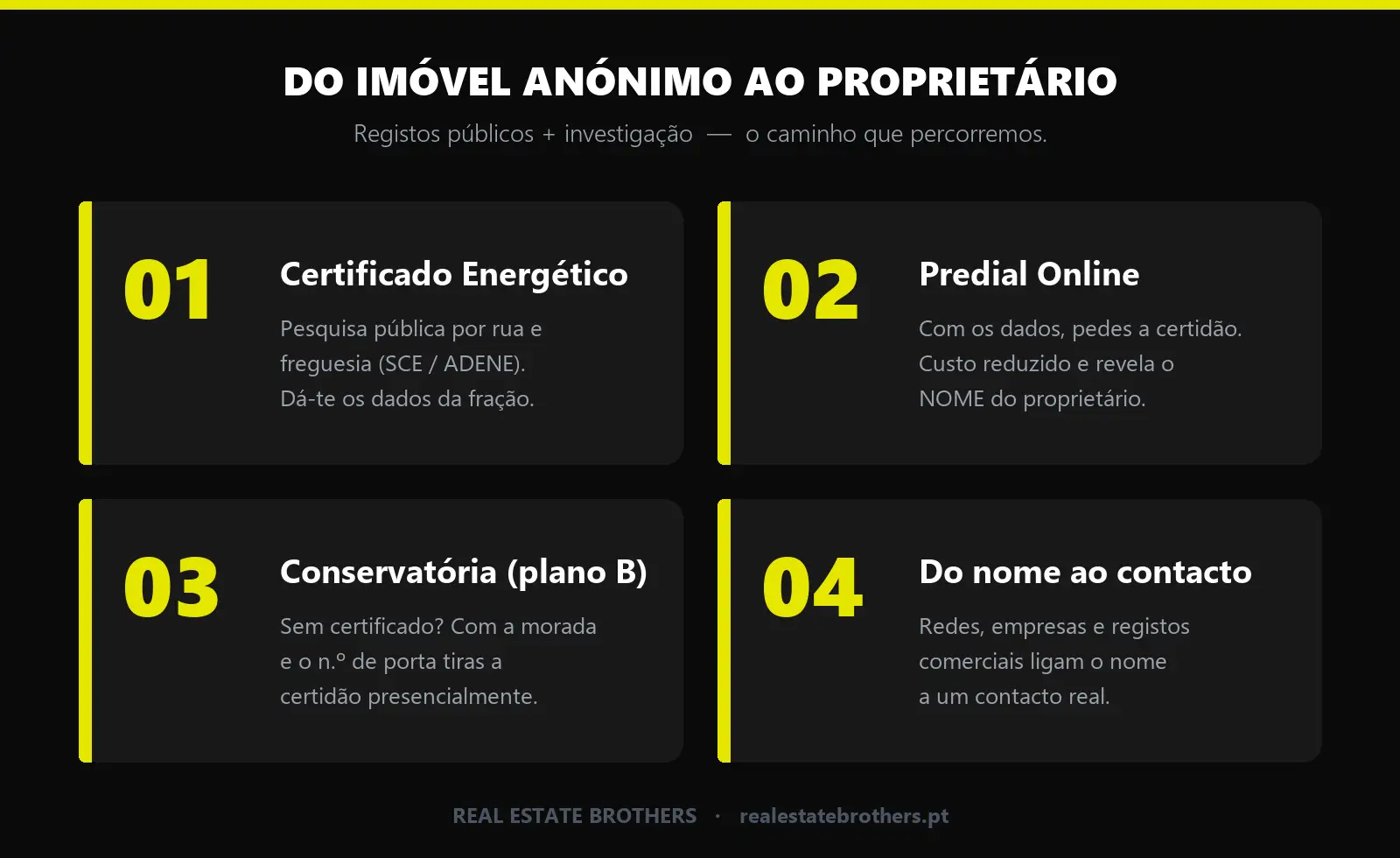
The goal of this first phase is simple: find out who the registered owner is. There are three routes to get there and, in practice, you will use them in this order.
Route 1: The Energy Certificate
Almost every property sold or rented in recent years was required to have an Energy Certificate, and that database is publicly searchable. Go to the Energy Certificate Search (SCE / ADENE) and search by address. If a certificate has been issued, you get the property's identification: typology, area and, above all, the details that identify the unit.
And here is the trick: it is precisely that identification you need in order to, in the next step, request the simple copy of the registry, the Informação Predial Simplificada. Without the certificate, you often have nowhere to start; with it, the rest follows.
Practical tip. In the search, type only the street name (e.g. “Roma” instead of “Avenida de Roma”) and then refine by district, municipality and parish. Too many results is better than too few.
Route 2: Predial Online
With the identification you took from the certificate, open Predial Online and request the simple copy. This is where the property stops being anonymous: for a small cost, you learn who is registered as the owner and, as a bonus, you see the charges on it: mortgages, liens, inheritances yet to be divided. There are two options:
- Informação Predial Simplificada, that simple copy: the cheapest, a symbolic cost of €1, valid for 12 months, informational in nature. It is perfectly enough for this phase.
- Certidão Permanente: €15, valid for 6 months, with legal standing (the one you will need later, at the deed).
Route 3: The registry office, when there is no certificate
Not every property has a recent energy certificate. If Route 1 fails, there is always a plan B: note the street name and the door number and go to a Conservatória do Registo Predial or Loja de Cidadão. With the address and the door number, you obtain the certificate in person. One way or another, you always get to the name.
The three routes, side by side:
| Tool | What it gives you | Approximate cost | Where |
|---|---|---|---|
| Energy Certificate | Unit details (typology, area, identification) | Free search | SCE / ADENE (online) |
| Predial Online | Owner's name + charges (mortgages, liens) | Inf. Simplificada: low · Certidão: €15 | predialonline.pt |
| Conservatória / Loja de Cidadão | Property certificate from the address + door number | ~€20 (in person) | Land Registry |
Practical example. You walk past an empty T2 on a street in Benfica. You search the address on the SCE: there is a 2021 certificate, confirming “T2, 64 m²”. You take those details to Predial Online and the Informação Predial Simplificada returns the owner's name, and a still-active mortgage. In ten minutes, the anonymous property has a name and context. Only the contact is missing.
Phase 2: From the name to the contact
You already have the name. Now it is about linking that name to a way of speaking with the person. Today, this is done with tools within anyone's reach: what changes is the discipline with which you use them:
- Social media: Facebook, Instagram and, above all, LinkedIn for professional profiles.
- Commercial registries: companies and shareholdings associated with the name provide formal phone numbers and emails.
- Mutual contacts: a shared connection is worth more than ten cold messages.
- Inheritances: when there are several owners, it is worth mapping the family before approaching.
Two cases that complicate things (and how to resolve them).
Is the owner a company? The name on the registry is a company: look up the NIPC, the management and the registered office; often the decision-maker is the managing partner, not the company address.
Are there several heirs? A property yet to be divided has several owners, and just one is enough to block the sale. Identify them all early and work out who the point of contact is; you save months.
The first approach: what to say (and what never to do)
Reaching the contact is half the work. The other half is the way you open the conversation, and this is where most people ruin it. The goal of the first contact is not to close a deal; it is to earn the second contact.
Introduce yourself with a name and a face, explain in two lines why you are getting in touch (you have genuine interest in that property), and ask an open question instead of making an offer. Something simple: you identify the property, say that you buy as-is and ask whether it would make sense to talk. Be direct about who you are and what you want (transparency is what earns trust) and always give an easy way out: a “if now is not the time, no problem” opens more doors than any insistence.
Where this fits in our method
None of this is theory. Identifying the property and reaching the contact is our Hunting; reading the certificate and understanding the charges (mortgages, liens) is already the Administrative and Legalhub, where we reduce risks before investing a single euro. It is the same method, applied to every project.
This is how some real deals came about, like the ones we show in our Completed Projects.
“We would rather lose a deal than take on a poorly calculated risk.”
Are you the owner of an idle property?
Perhaps you do not need anyone to track you down. An inheritance to be divided, debts, a lien or just the wish to resolve it? Let us talk. We buy as-is and give an offer within 48 hours, with no commitment and no cost.
Do you want to invest in deals like these?
This is how we find off-market opportunities, at prices with a safety margin. If you want to invest with conservative figures and transparent reporting from purchase to sale, see how it works.
Useful resources
- Energy Certificate Search (SCE / ADENE)
- Predial Online (certificates and Informação Predial Simplificada)
- Request a certificate at the land registry (Justiça.gov.pt)
Do you have a property in mind and do not know where to start? Talk to our team: it is what we do every day.
Note: the costs and procedures of public services may change: always confirm the amounts and steps on the official websites. This content is informational and does not replace legal advice.